
 Deutsch
Story
Next Big Step (June 2025)
From an Idea to Research – TOURELLY becomes scientifically precise.
June 2025 was a milestone that changed everything for us. After months of preparation, documentation, and coordination, we finally received the FFG funding approval – giving us not only financial support but also a massive boost in motivation.
This approval meant: We could finally increase the pace.
For the first time, it became possible for not only Philip but also Ajmal and Ashkan to work full-time on the project – something that simply wasn’t financially possible before.
Suddenly, we had the resources to shorten development cycles, run more tests, and work on multiple components in parallel.
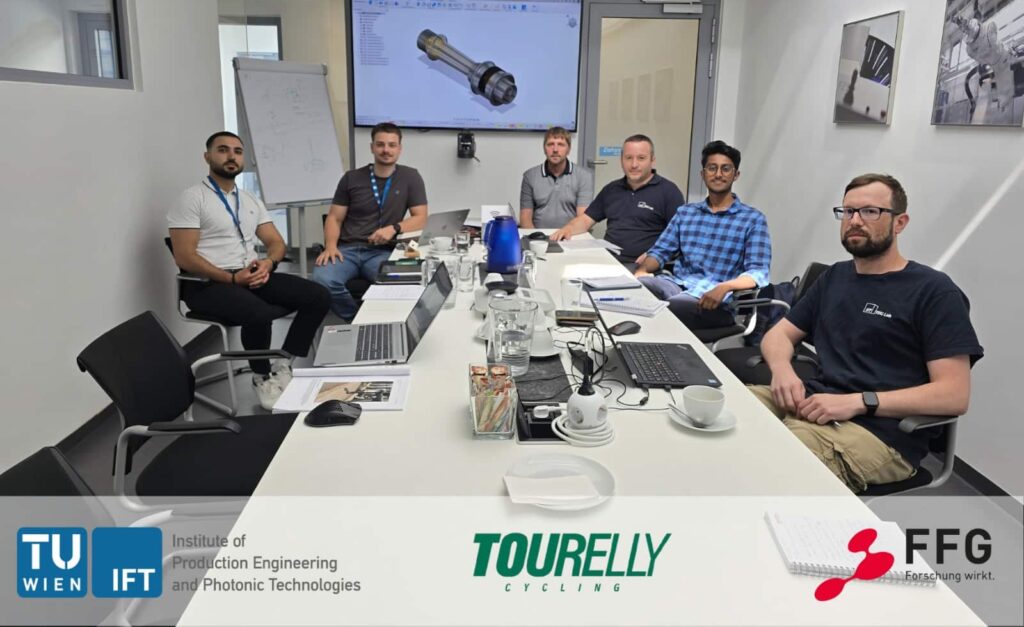
And it was exactly at this stage that our intensive collaboration with TU Wien began – a partnership that had already started to take shape months earlier at the 4GameChangers Festival. TU Wien became our official research partner and opened the doors to precise simulations, in-depth analyses, and a level of academic expertise only a scientific institution can provide.
From then on, we held weekly calls to discuss new approaches, share data, and plan prototypes.
Together with the TU team, we immediately started testing new ideas:
- a revised cleat concept with a simpler structure and more efficient power transfer,
- a redesigned pedal body with a larger contact surface,
- a stronger axle that would finally survive the next round of testing.
Thanks to the simulations, we were also able to significantly improve the spring characteristics. They can now be manufactured with much higher precision – using two parameters that individually define both the stiffness and the click point.
In parallel, the axle is currently being further optimized through structural simulations to reduce weight without sacrificing stability.
You can feel it: everything is reaching a new level – function, weight, materials, design – every detail becoming finer, more refined, more deliberate.
Our goal is clearly defined: By the end of the year, we want to produce 20 test pairs that will be handed over to selected riders to gather the final learnings for the early-adopter series in May 2026 – planned with a production run of 300 pedal pairs.
What began three years ago as a simple idea in a Viennese bike shop is now a technologically advanced, funded development project. And the best part: We’re only just getting started.